
The season at our golden eagle hides in Finland is long. We start feeding the eagles in September, and the season continues until March. Within these months, however, there are several quite different periods for photography.
Autumn is perhaps the shortest of them, but also one of the most interesting.
For a photographer, September and early October feel very different from the more familiar winter eagle photography. There is still plenty of daylight, the landscape has colour, and rain can create a completely different atmosphere. It is a short window, and perhaps this is one reason why we see far fewer autumn photographs of golden eagles than winter ones.
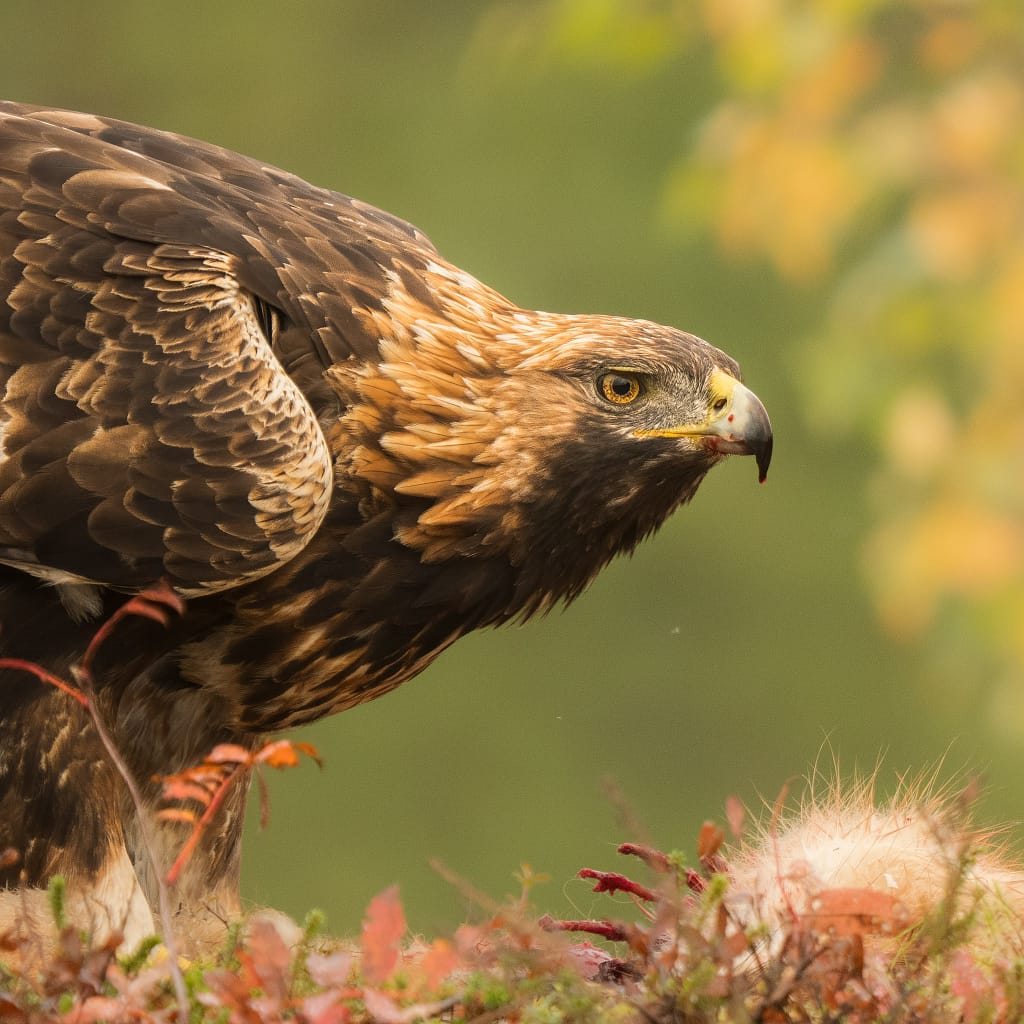
Golden Eagles in Autumn Colours
The obvious attraction is the golden eagle.
Autumn colours can make these photographs stand out from the more typical winter images. Instead of snow and a mostly white landscape, there can be yellow and orange vegetation, darker backgrounds and wet autumn colours. Rain also works surprisingly well. An eagle against autumn vegetation can have a very different feeling from the same bird photographed a few months later in snow.
The activity at the feeding site can also be good. Often the local breeding pair are among the first eagles to return. If they have had a successful breeding season, their young eagle may also visit the site. Other golden eagles can appear as well.
This autumn, for example, we have had at least three different young golden eagles visiting.
We can tell this partly from their plumage. Golden eagles do not get their full adult plumage until they are 6-7 years old, and the amount and pattern of white in the wings and tail changes as they mature. By looking at these differences, we have been able to see that young eagles of different ages have visited the feeding site.
One of the approximately three- to four-year-old birds has also been colour-ringed. This has made it easy to separate it from another eagle of roughly the same age.
A couple of white-tailed eagles have visited as well, although so far they have mostly stayed in the trees and watched what is happening.
With several eagles around, there is always the possibility of interaction. The resident pair may defend the food against visiting birds, and this can create some interesting situations. In years when the pair has a young bird with them, I also enjoy watching the communication between the adults and their offspring.
There is much more happening than simply waiting for an eagle to land in front of the hide.
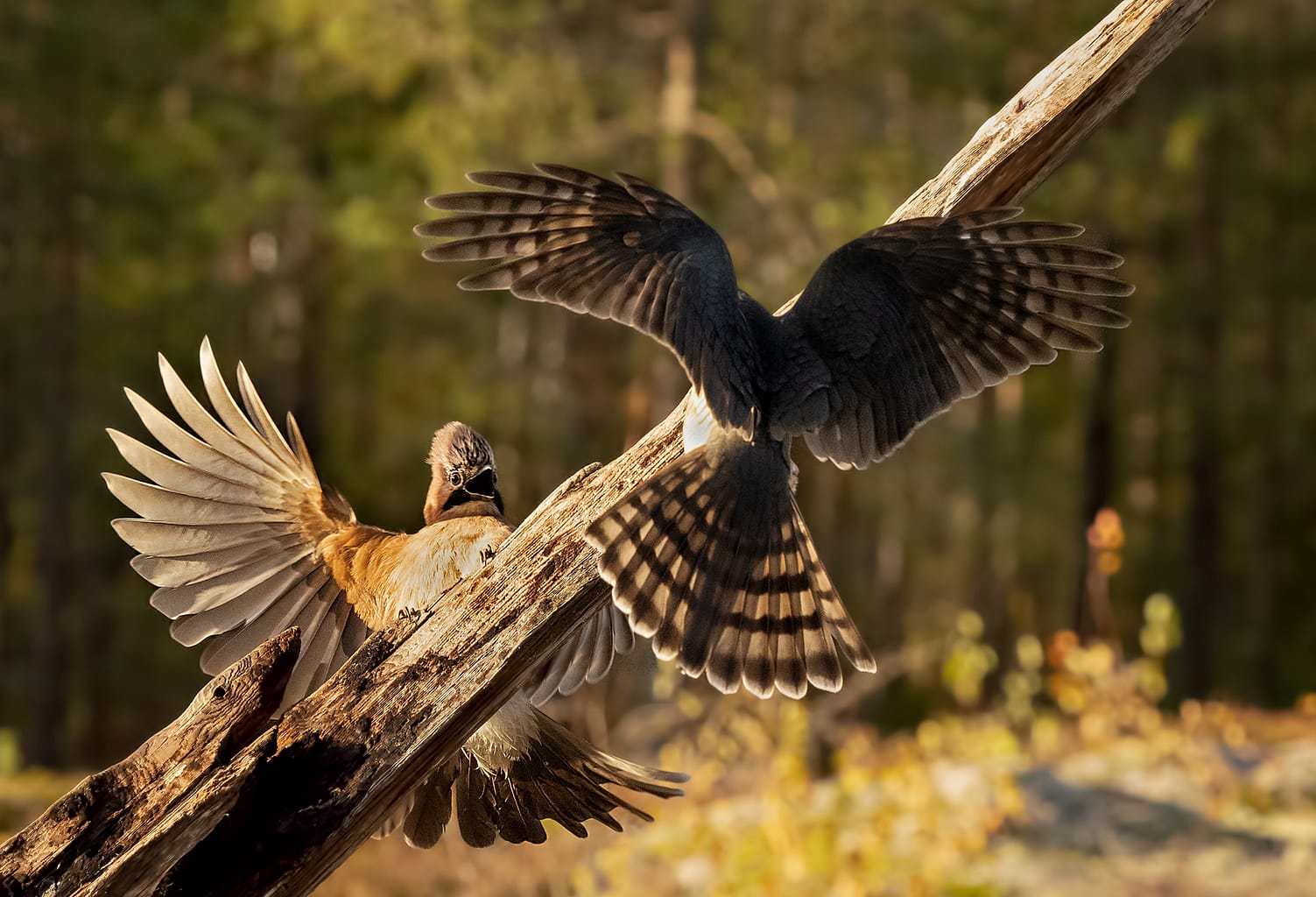
The Sparrowhawks Keep Photographers Busy
For me, however, one of the most enjoyable parts of the autumn season is something much smaller.
The sparrowhawks.
September is usually a very good time for them around the feeding site. They are attracted by the activity of the jays, and on some days there can be several sparrowhawks around. Both young and adult birds may appear.
Their behaviour with the jays is fascinating to watch. I cannot say exactly what is happening between them, but at times it looks almost like a game.
A sparrowhawk chases a jay from its perch. A short while later, the jay returns to exactly the same branch and seems to wait for the sparrowhawk to come back. Then the chase starts again.

For a photographer, this is completely different from photographing a golden eagle.
Everything happens very quickly. The birds change direction constantly, disappear behind trees and return without warning. There is very little time to think once something starts happening.
Sometimes the sparrowhawks make things even more difficult by deciding to chase avens. Those encounters usually happen in flight, and getting both birds into the frame is another challenge entirely.
Occasionally, a particularly brave sparrowhawk even tries its luck with a golden eagle.
It is quite a sight to see such a small raptor going after a bird many times its own size.

Sometimes Something Unexpected Appears
Golden eagles and sparrowhawks are the species we expect, but autumn has also produced a few surprises.
For three autumns in a row now, some of our guests have been lucky enough to photograph a wolverine from the eagle hides.
This is certainly not something that can be expected. Wolverines do not visit every day, or even regularly enough that I would consider them part of a normal day at the hides. But on a few days each autumn, somebody has been in the right place at the right time.
So far, I have not been one of them.
Despite spending plenty of time around our eagle hides, I still have not seen a wolverine there myself. This is also part of wildlife photography. Being familiar with a place does not mean that you get to see everything that happens there.

Long Days, but Plenty of Light
There is one practical difference between autumn and winter that is easy to underestimate.
The days are long.
In September, a day in the hide can be close to 12 hours. That is a long time to sit mostly in one place while remaining ready to photograph.
On the other hand, all those hours of daylight give us much more light to work with. Even on cloudy autumn days, there is generally more usable light than during the darkest part of the Finnish winter. This makes autumn a little less demanding photographically, especially when the action becomes fast.
Conditions outside the hide are also easier.
When we arrive in autumn, the hide is already reasonably warm, and heating makes the day comfortable. There is no need to think about whether the car will start after sitting outside in very cold temperatures, which can be a real consideration in some days in January and February.
Nor do we usually have the problem that comes with warmer days in March, when a frozen road can turn into deep slush during the day.
These are small practical things, but after many days in hides I have learned that they matter.

A Short Window in the Eagle Season
Winter will probably always be the season most closely associated with golden eagle photography in Finland. Snow creates clean photographs, the days become shorter, and the whole experience has its own character.
But autumn gives something different.
The colours are richer, there is more light, and the activity around the feeding site is not limited to the eagles. On a good September day I may be watching a golden eagle one moment and trying to keep a sparrowhawk and a jay in the frame the next.
And occasionally something completely unexpected walks into view.
The autumn window is short. Perhaps that is part of what makes it interesting. A few weeks later the colours are gone, the days are rapidly getting shorter, and the same place begins to look like a completely different landscape.
For me, that change is one of the interesting parts of returning to the same hides throughout the season.



Leave a Reply