
After the light nights of summer, darkness returns surprisingly quickly to Finland.
By September, we have proper dark nights again, and with them one of my favourite autumn photography subjects returns – the northern lights.
Many people associate northern light photography with winter. Snow, frozen trees and very cold nights are the classic image of Lapland.
But winter is not necessarily the best time for aurora activity.
Statistically, March and September are particularly interesting months, with geomagnetic activity tending to increase around the spring and autumn equinoxes.
Northern lights are not only a winter subject
Winter is often marketed as the northern lights season in Finland. There is some logic to this. Winter nights are long and dark, which gives plenty of hours when aurora can be visible.
But darkness itself does not create northern lights.
Aurora activity is connected to charged particles and magnetic fields coming from the Sun interacting with Earth’s magnetic field. When the conditions are right, particles are directed into the upper atmosphere, where their interaction with gases such as oxygen and nitrogen produces the light we see as aurora.
This can happen throughout the year. The problem during Finnish summer is simply that the sky does not become dark enough in much of the country to see it properly. By late August and September, darkness has returned.
September is particularly interesting because of the autumn equinox, which occurs in the second half of the month. In 2026, it falls on September 23. Around the equinoxes, geomagnetic activity tends to increase, so there is a seasonal peak in auroral activity around September. A similar increase occurs again around the spring equinox in March. This seasonal pattern has been known for a long time and is connected to the way the solar wind interacts with Earth’s magnetic field.
Of course, the equinox does not mean there will be northern lights every night. The Sun still has to provide the right conditions, and those conditions have to reach Earth in a way that produces auroral activity. The equinox improves the statistics. It does not make a promise.
There is also one very practical reason why I like photographing northern lights in autumn. The nights are dark again, but the temperatures are usually much more comfortable. In midwinter, good northern lights nights seem all too often to arrive together with serious cold. In September, I can sometimes spend hours outside with the camera without freezing. After enough winter nights in the field, I consider that a real advantage.
The difficult part is getting the timing right
With northern lights photography, I can choose and prepare the location well in advance. The difficult part is knowing when the right conditions will come together. Solar activity has to be suitable, the sky needs to be dark, and clouds need to stay away.
This is why phone apps are so valuable. I usually follow more than one source: one for solar wind and the probability of auroral activity, another for the weather forecast and cloud cover. They help me decide when it is worth going out, but they are still only forecasts. Once I am in the field, the situation can be quite different. The aurora may be weaker than expected, clouds may arrive at the wrong moment, or conditions may turn out much better than predicted.
This is quite different from much of the wildlife photography I do. With birds and mammals, we can sometimes improve our chances by using food, and experience helps us understand where and when an animal is likely to appear. With the northern lights, there is much less we can influence. I can study the forecasts, choose the location and be ready, but eventually I have to go outside and see what the sky is actually doing.
For someone travelling to Finland for only a few days, this makes northern lights photography especially unpredictable. The location can be planned in advance, but whether clear skies and auroral activity come together during those particular nights still depends partly on luck.
This is also why we never sell trips that are based only on photographing the northern lights. There are simply too many things we cannot control. Northern lights can be an excellent part of a photography trip when the conditions are right, but I would not want the success of an entire trip to depend on something that may or may not happen.
Open water changes the photograph
For me, one of the biggest photographic advantages of autumn is water.
In winter, lakes across Finland freeze. By September, they are normally still open.
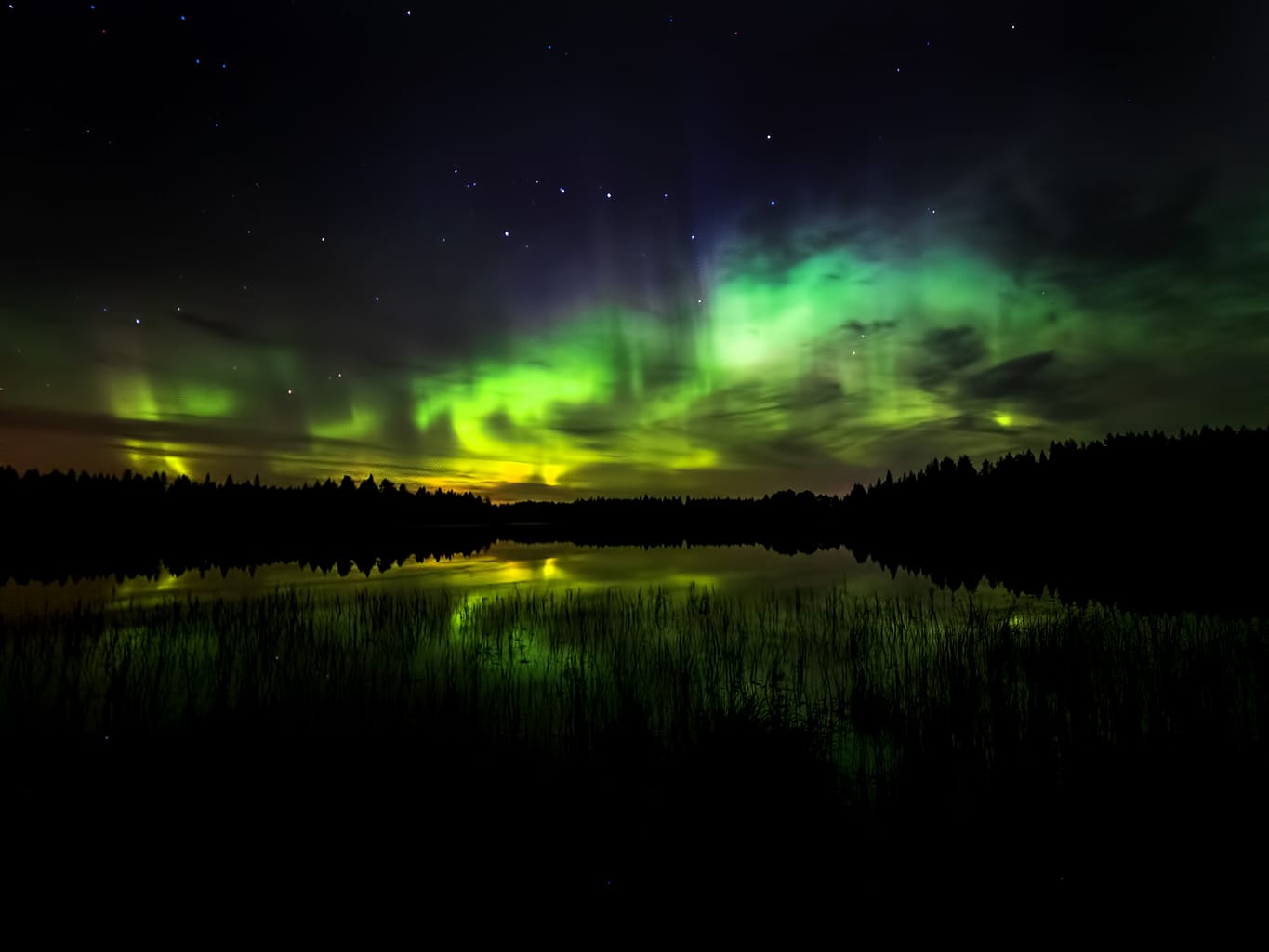
A calm autumn night can therefore give me something that is impossible in the same location a few months later – a reflection.
When the surface of a lake becomes still, the northern lights can appear both in the sky and in the water below. The landscape becomes a much bigger part of the photograph.
I like this because I rarely want to photograph only the aurora itself.
A strong display is impressive, of course, but I still need to think about the photograph in the same way I would with any other subject. I look for a foreground, shapes in the landscape and some balance in the frame.
The northern lights are part of the photograph rather than automatically being the whole photograph.
Open water gives me more possibilities to work with this.

What I look for when photographing aurora
When conditions look promising, I think about the location before I think too much about the camera.
A dark place away from unnecessary artificial light helps, but photographically I also want something in the landscape.
In autumn, a lake is an obvious possibility. Trees, small islands and the shape of the shoreline can all help to give structure to the image.
Then I wait to see what the aurora does.
A weak green arc close to the horizon requires a different composition and very different camera settings from a strong display spreading across the sky. Often the most interesting part is directly north, while during stronger activity the aurora can extend much farther across the sky.
People often ask me for exact camera settings before going out, but with northern lights they are almost impossible to give in advance. The intensity and movement can change quickly, and my settings have to change with them.
With weak aurora, I may use an exposure of several seconds — five seconds, for example, is nothing unusual. But if I use the same settings when the aurora becomes strong and starts moving quickly, the result can easily become a bright green blur with very little structure. In those conditions, I often prefer an exposure of around one or two seconds.
This is why I treat northern lights settings as a starting point rather than a recipe. Once I see what is actually happening in the sky, I adjust from there.
Cameras see more than our eyes
One interesting thing about northern lights photography is that the camera and the human eye do not always see the same thing.
With weaker aurora, the colour may look quite subtle to the eye. A camera can record it much more clearly. A faint structure in the sky can already appear distinctly green in a photograph, even when our eyes see little colour.
This difference is worth remembering when looking at northern lights photographs online. I often see images where the colours have been pushed very far in post-processing, especially the reds and magentas. The result can be impressive on a small screen and probably attracts attention, but it does not necessarily have much connection with what was visible to the photographer at the time.
In the north, clearly visible red aurora is something I associate with genuinely strong displays. A modern camera can record red much earlier and much more easily than our eyes can see it. This does not mean the colour recorded by the camera is false, but there is a difference between recording colour that our eyes struggle to see and pushing that colour much further afterwards.
During strong activity, of course, the experience can be completely different. Colours and movement can become obvious without a camera, and those are the nights that stay in my memory.
For me, this is also a good reason to look up from the camera from time to time. If I want my photographs to show the northern lights in a natural way, I need to remember what they actually looked like to my eyes. The camera may record more colour than I can see, but my own impression of the sky is still an important reference when I process the images later.

September is a short opportunity
Autumn northern lights photography in Finland sits in a relatively narrow window.
Dark nights have returned, but winter has not.
The lakes are open. The landscape can still have autumn colour. Temperatures are usually much easier than in January or February.
And at the same time, September is statistically one of the more interesting periods of the year for aurora activity.
None of this guarantees a photograph.
There can be clouds for several nights. The aurora can remain weak. A good display can happen one night before I arrive or one night after I leave.
That uncertainty never disappears.
There is something special about standing beside a completely still lake on a dark autumn night and seeing the first green shapes beginning to appear in the sky.
A few months later, the same lake will be frozen and covered with snow.
For a short time in autumn, I can photograph the northern lights twice.
Once above me, and once in the water.



Leave a Reply